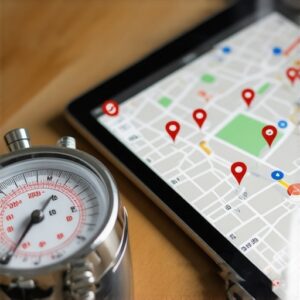
The street smells like wet concrete after a summer storm. I stand on the corner watching the light hit a storefront that according to the digital map does not exist. This is the glitch in the local database. As a veteran strategist who has spent decades investigating map spam, I see the forensic traces of digital war everywhere. A business listing is not just a profile. It is a proximity beacon in a spatial database governed by mathematical weights and geographical salience. When those coordinates are attacked by malicious actors, the fallout is not just digital. It is a loss of real revenue and physical foot traffic.
The midnight extortion at the local cafe
Malicious spam reviews and coordinated rating attacks are detected by analyzing user profile velocity, VPN IP signatures, and geospatial check-in signals. Google uses behavioral heuristics to flag review clusters that lack mobile device proximity data or transactional evidence. Identifying these spam patterns requires forensic audit tools and GMB management software.
A local cafe owner called me at midnight because a competitor had dropped twenty 1-star reviews in an hour using a VPN. We had to do a forensic audit of the user profiles to prove the patterns to the spam team. It was not just about the text of the reviews. It was the lack of any corresponding GPS movement from those accounts. None of the accounts had ever been within five miles of the shop. This is where the algorithm failed initially, allowing the attack to tank the ranking for forty-eight hours. We had to document the lack of local justification triggers to get the removal team to act. This process is part of handling hostile reviews without hurting your local search standing during an active crisis. The pin moved in the wrong direction for two days, and the revenue loss was visible in the empty tables. This is why defending your reputation is a technical necessity, not just a PR move.
The mathematical weight of a fake rating
Sentiment analysis engines quantify local trust signals by weighing the authority of the reviewer against the historical check-in data of the account. High-velocity negative feedback loops trigger a protective suppression filter that can hide a Google Business Profile from the Local Pack. Businesses must use reputation management tools to monitor review sentiment trends.
The logic of a check-in signal is complex. Google knows when a mobile device sits at your address for twenty minutes. If a 1-star review comes from an account that has never been at your GPS coordinates, the weight of that review should theoretically be zero. However, the system is not perfect. Sometimes it takes manual intervention to point out the forensic traces of fraud. This is why you need to understand reporting map spam how to get quick results from Google before your profile gets buried. I have seen legitimate businesses vanish because they did not have a defense plan. The physics of a three-mile proximity radius shift means that even a minor drop in your average rating can push you off the first page for users just a block away. It is a game of centimeters and decimals. Use 7 local ranking tools that actually show you the truth about your map position to see how an attack is moving your pin in real time.
“Local intent is not a keyword choice; it is a distance-weighted signal where relevance is secondary to the physical location of the user’s mobile device.” – Map Search Fundamental
Technical fixes for local visibility loss
Technical SEO services are required to fix indexing and crawling issues that prevent local landing pages from validating GMB data. Optimizing JSON-LD LocalBusiness schemas and NAP consistency ensures that Map Pack rankings remain stable during core algorithm updates. Using google business profile seo tools for agencies helps identify metadata errors.
When the map pin drops, people look at reviews first, but the problem is often deeper in the code. I often find that a site deranked because of technical SEO fixes for local websites that lost their rank were ignored. If your website goes down for even a few hours, Google might lose trust in your physical location. There is a strong correlation between website health and map rankings that most small business owners overlook. They focus on the star rating while their robots.txt file is blocking the very pages that prove they are local experts. I have spent months fighting suspensions because a client had 3 messy SEO errors that keep your shop out of the local map pack hidden in their source code. You need the toolkit every local business needs for map pack success to catch these issues before they become permanent liabilities.
Local Authority Reading List
- The Reinstatement Checklist
- Why Your Map Pin Dropped After Website Downtime
- The Cleanup Plan For Deleted Reviews
- Manual Audits vs Automated Software
Why your physical address is a liability
Physical office verification is the primary trust anchor for Google Business Profiles. Address changes or virtual office usage triggers hard suspensions that require utility bill documentation and video verification. Businesses must audit their service area polygons to ensure they do not overlap with competitor proximity filters.
I have seen agencies sell address rentals to unsuspecting plumbers and lawyers. These are death traps. Google is now using 2026-level imagery analysis to see if your office has a permanent sign. If you are using a virtual space, you are essentially invisible to the local algorithm. Understanding why virtual offices get suspended and how to fix it is vital if you want to survive. The ranking cost of changing your physical service location is high. Sometimes the pin vanishes exactly five miles from your office for no apparent reason. This is the Vicinity filter at work. It narrows the radius to favor businesses that are physically closer to the user. If you move, you need to follow the ranking cost of changing your physical service location guidelines to avoid a total collapse. Always check how to verify your actual physical location for GMB to keep the trust score high.
Forensic tools to identify map spam
Local SEO software to improve map pack rankings must include competitor spam detection and category gap analysis. Tools that monitor keyword-stuffed business names allow for redressal form submissions that clean up the local ecosystem. Successful local lead generation depends on clean map data and verified listings.
The map is a war zone. Bots are creating thousands of fake listings every day to steal your leads. You need to be exposing the fake businesses stealing your local leads by looking for patterns in their names. If every competitor has the word “Best Plumber” in their title but their legal name is just “John’s Pipes,” they are violating terms. I enjoy fighting local map spam a strategy for cleaning up your niche because it levels the playing field for honest owners. Use the spam report guide taking back the map pack from bots to reclaim your territory. Most agencies use general SEO software that is useless for fixing local GMB visibility because it does not track the specific spatial metrics that matter. You need why general SEO software is useless for fixing local GMB visibility data to understand why your rank trackers might be lying to you.
“Relevance in local search is a distance-weighted signal where the proximity of the user’s mobile device is the primary ranking factor, making the physical address a critical data point.” – Local Search Intelligence Report
Strategic recovery after an algorithm hit
SEO services to recover traffic after a Google update involve content audits and backlink profile cleanup. Fixing over-optimized anchor text and removing thin location pages restores topical authority. A recovery plan must address manual actions and algorithmic filters simultaneously.
When a core update hits, the first thing that happens is usually a drop in organic rankings, but sometimes the map pack stays stable. Other times, it is the opposite. Understanding when organic rankings drop but maps stay what it means can save you from panicking. If you lost traffic, you might need recovering lost organic traffic after a sudden google algorithm shift protocols to find the root cause. Often, it is a matter of balancing anchor text for local relevance without over optimization. If every link to your site says “Plumber Chicago,” you are going to get flagged. You have to clean up your link profile for better local map positions to show Google you are a real business, not a link farm. We have seen success restoring visibility to a deranked website after a core update by simply removing the AI fluff that was triggered by the latest quality filters. Always focus on escape the ai penalty high quality content for local search to stay safe.
Cleaning up the debris of old locations
Local SEO services to clean up old or closed locations prevent NAP confusion and listing duplicates. Properly merging business profiles and redirecting old location pages maintains local ranking power. Correcting mixed-language metadata improves user experience and search visibility.
Leaving old listings active is like leaving trash on the street. It confuses both users and the algorithm. If you have moved, you must engage in local listing cleanup why mixed language data tanks conversions strategies. Mixed signals lead to a lower trust score. I have seen businesses lose 50 percent of their calls because their old office was still ranking for their primary keywords. You need a the map ranking fix for service businesses changing territory to ensure a smooth transition. This involves cleaning up the localized metadata mess for map listings so that the search engine knows exactly where you are today. If you are struggling with a multi-region strategy, remember that why your multi-region listings need a unified language strategy is the foundation of global-local success. Don’t let your past locations haunt your current rankings. Clean them up using a step-by-step fix for suspended local business listings if they get flagged during the move.