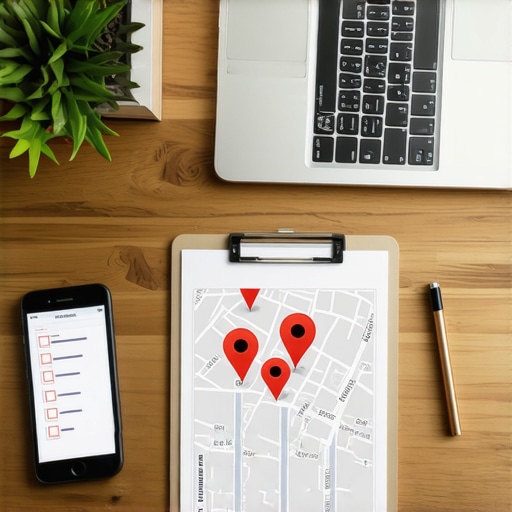
The smell of wet concrete often lingers in the air when I walk through a city center. I notice the gaps in the storefront data like a photographer notices a glitch in a lens. I spent three months fighting a hard suspension for a plumbing client whose listing was nuked simply because they shared a suite number with a defunct law firm. Google did not want proof of a van. They wanted proof of a utility bill under the exact GPS pin. The pin moved. The trust vanished. This is the reality of the hyper-local layer where a single digit in a suite number can destroy a decade of reputation. You need a manual Google Business Profile audit that looks past the surface of the dashboard to the spatial database underneath. Successful practitioners use utility bill verification, GPS coordinate validation, and category gap analysis to win the Map Pack. Relying on automated tools often leads to ranking filters and profile suspensions because they miss the physical proximity signals. Any audit must focus on NAP consistency and primary category relevance to ensure local search visibility.
The ghost in the GPS coordinates
GPS coordinate salience and centroid proximity are the mathematical foundations of every local search result. While many assume that an address is just a string of text, Google sees a precise point on a grid. If that point overlaps with a virtual office or a coworking space, the algorithm triggers a proximity filter. I have seen businesses disappear because their pin was moved ten feet to the wrong side of a building wall. You must check your latitude and longitude in the dashboard against the actual entrance of your building. If you are struggling with why virtual offices get suspended and how to fix it, the answer usually lies in the lack of a dedicated physical entrance. The algorithm is looking for a proximity beacon that does not share a signal with a dozen other entities. When the density of businesses at a single point becomes too high, the Map Pack suppresses all but the most authoritative profile. This is why how to verify your actual physical location for GMB is the first step in any manual audit. You need to look at the Street View data. If the camera car saw a mailbox store where you claim a headquarters exists, you have already lost the battle. The forensic trace of your business must exist in the real world before it can exist in the Map Pack.
“Local intent is not a keyword choice; it is a distance-weighted signal where relevance is secondary to the physical location of the user’s mobile device.” – Map Search Fundamental
Why your physical address is a liability
Physical location verification and address normalization are the only ways to survive a suspension wave. Most owners treat their address as a suggestion. They add suite numbers that do not exist or use keyword stuffed business names to try and game the system. This behavior is a massive liability. I once investigated a roofer who used a UPS Store address for three years. He ranked number one until a competitor used reporting the keyword stuffed profiles of local competitors to flag his listing. He lost his entire livelihood in twenty four hours. An audit must include a paperwork review. Do you have a lease? Do you have a utility bill? If you do not have the paperwork you need to fix a suspicious address suspension, you should not even be on the map. The algorithm has become aggressive about address changes. If you move, you need a strategy for stabilizing your local search presence after moving locations. A manual audit looks for NAP mismatches across the web. A single old listing on a defunct directory can confuse the local algorithm and cause a ranking drop.
Local Authority Reading List
- The essential toolset for businesses sick of losing to local competitors
- A step by step fix for suspended local business listings
- The audit that finds ai generated spam on your local site
- The difference between real ranking tools and worthless rank trackers
The three mile radius that determines your revenue
Proximity radius shifts and service area polygons dictate which customers actually see your business on their phones. If you are a service area business, you do not have a physical storefront for customers to visit. You define your reach through service areas. Many people fail here by selecting too large an area. If you claim an entire state, Google will likely ignore you. You must be specific. An audit should verify that your service area does not overlap with hidden locations or duplicate profiles. If you are recovering your map position after changing your service area boundaries, you must understand that the centroid of the city is your primary competitor. The closer you are to the user, the higher you rank. This is why why your service area expansion failed to rank on maps is a common complaint. You cannot just check a box and expect to dominate a new city. You need local justifications. These are the small snippets of text that say “Provides plumbing services in this area” or “Website mentions water heater repair.” These triggers are pulled from your website health. If you have technical seo fixes for local websites that lost their rank, your GMB profile will suffer. The two are inextricably linked. The local search engine uses your website to verify the claims made in your business profile.
The hidden cost of digital deception
Keyword stuffing and fake reviews are the fastest ways to trigger a manual review from the spam team. I hate agencies that sell review blasts. They use VPNs and aged accounts to create a false sentiment score. Google sees the pattern. They see twenty reviews from accounts that have never been to your city. During an audit, I look at the reviewer history. If the reviews look like AI generated fluff, they are a ticking time bomb. You should be defending your local profile from malicious spam reviews by reporting them immediately. The same applies to your name. If your legal name is “Smith Plumbing” but your profile says “Best Dallas Plumber Emergency Repair,” you are in danger. You must understand why your keyword stuffed profile is actually hurting your rank. It creates a trust gap. The algorithm eventually catches up and filters you out of the Map Pack entirely. A manual audit involves how we stripped keyword stuffing to save a local ranking by reverting the name to match the legal LLC documentation. It hurts for a week. Then the rankings stabilize and stay. Real local seo is about longevity, not quick wins.
“Relevance is a filter, but distance is the lock. If the proximity beacon does not pulse within the expected quadrant, the ranking falls regardless of authority.” – Spatial Intelligence Whitepaper
The category research framework for success
Primary category selection and secondary category gaps are the levers that control your keyword reach. Most businesses pick one category and stop. This is a mistake. An audit must examine what the top three competitors are using. Are they using “Plumber” or “Heating Contractor”? Using the category research tactic that finds low competition keywords can help you find niche categories that others missed. For example, a landscaping company might also qualify for “Sprinkler Repair” or “Lawn Care Service.” If you choose selecting the right gmb categories to avoid keyword overlap, you prevent your own listings from competing with each other in a multi location setup. I have worked on multi location businesses where the owner had five shops in one city. They were all competing for the same primary category. By diversifying the secondary categories, we were able to capture 100 percent of the Map Pack results. This is how how we synchronize local seo across multiple storefronts efficiently without triggering a duplicate listing filter. You must be precise with your niche selection. If the category does not fit, do not use it. Google is watching the click through rate. If you rank for a category you do not service, users will bounce, and your trust score will drop.
Forensic evidence in the review section
Review sentiment analysis and image metadata are the new frontiers of the local algorithm. When a customer uploads a photo, Google reads the EXIF data. They know the GPS coordinates of where that photo was taken. If all your photos come from a stock photography site, you are signaling to the engine that you are not actually there. An audit should prioritize user generated content. I tell my clients to ask customers to take photos of the finished job. This provides physical proof of service. Additionally, the keywords in reviews matter more than the keywords in your description. If customers keep mentioning “best 24 hour plumber,” Google will start ranking you for that long tail keyword. If you are handling hostile reviews without hurting your local search standing, you need to respond with expertise. Do not get emotional. Mention the service provided and the location. This adds local relevance to the review thread. A manual audit identifies these sentiment gaps. If your competitors have five hundred reviews and you have ten, you are not losing because of a software glitch. You are losing because of a trust deficit. You need a practical map ranking toolkit for small business owners to bridge that gap systematically.
The math of the three mile radius
Spatial data integration and website health are the final pieces of the manual audit. If your website is slow, or if it has malware, your Google Maps ranking will die. I have seen it happen a hundred times. A client calls because they dropped from the Map Pack. I find a redirect loop on their contact page. If you want to know why malware on your site kills your google maps position, it is because Google will not send a mobile user to a dangerous site. An audit must include a technical scan of the linked website. Use identifying the technical errors causing your site to derank as your checklist. Your internal linking must also support your local pages. If you are rebalancing your internal links for local relevance, you are essentially telling the crawler which physical location is most important. Every location page on your site should have a Google Map embed and schema markup that matches your GMB profile exactly. Any discrepancy is a red flag. The engine wants perfect symmetry between your off page profile and your on page signals. Without this symmetry, you are just a ghost in the machine. Stop looking for ranking hacks. Start looking at the physical reality of your data footprint. That is how you win the Map Pack in 2025 and beyond.