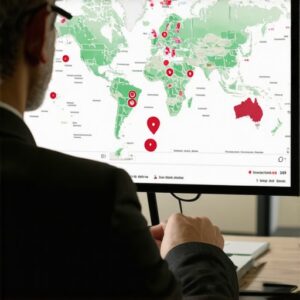
Changing your physical coordinates or service boundaries can instantly disrupt your local search performance. When you alter your geographic reach, the algorithm recalculates your proximity relevance, which can trigger an abrupt drop in your local map rankings. To recover your visibility, you must systematically update your business signals, audit your citations, and prove your real-world presence to search engines.
The service area expansion crisis
Rebuilding local visibility after a service area change requires correcting fragmented coordinates and outdated address signals. Many small businesses lose their hard-earned local rankings because search engine crawlers detect conflicting location data across the web. To restore trust, you must align your Google Business Profile with structured schema, clean citations, and location-specific authority signals.
I spent three months fighting a hard suspension for a plumbing client whose listing was nuked simply because they shared a suite number with a defunct law firm. Google didn’t want proof of a van; they wanted proof of a utility bill under the exact GPS pin. This battle showed me that local search is a game of physical evidence. When you change your boundaries, the automated systems flag you as a potential ghost listing, requiring manual intervention and deep technical precision to fix. If your business depends on regional service areas, you cannot rely on automated software to solve these deep coordinate conflicts; you must execute a forensic audit of your digital footprint.
“Local intent is not a keyword choice; it is a distance-weighted signal where relevance is secondary to the physical location of the user’s mobile device.” – Map Search Fundamental
The physics of proximity based drops
A sudden drop in local map rankings usually occurs because search engines no longer associate your profile with the target search centroid. When you expand or shift your service parameters, the old proximity signals weaken while new ones are not yet trusted. This creates a spatial vacuum that competitor profiles will quickly exploit. To diagnose this, search specialists look at local historical proximity tracking to see exactly where your trust signals are failing.
To stop this decline, you must analyze how your business presents its physical operating region. Relying on basic tools will not show you the real problems. For a thorough review, the essential toolkit for a manual Google Business Profile audit will help you identify hidden coordinate flags that automated platforms miss. By manually examining your profile, you can spot the discrepancies that cause proximity-based drops.
Many business owners try to fix their drop by purchasing automated software, but these platforms often fail to locate the actual errors. Instead, look into why manual audits beat automated ranking software every time to understand how hands-on diagnostics save your search presence. Correcting these errors by hand ensures that your location data is pristine and authoritative.
The blueprint for service area recovery
A successful recovery plan for updated service areas requires verifying your brand signals across every platform. You must update your address, update your local schema, and confirm that your digital footprint matches your real-world service territory. Skipping these manual steps will lead to persistent ranking drops.
First, update your service area boundaries inside your dashboard. Do not draw overly broad shapes that cover entire states if you cannot serve them, as search engines will discount these bloated areas. Instead, specify the exact postal codes where you operate. This precision helps establish clear service-area signals. If you are experiencing a severe drop in map impressions, you must follow the specific steps to regain map impressions for service area businesses to restore your local reach.
Second, audit your external citations. Old addresses and incorrect phone numbers on third-party directories will confuse search crawlers and degrade your authority. Resolving these issues is a priority. Learn why cleaning up old citations is the first step to a map recovery to lay a solid foundation for your updated profile. A clean citation profile tells search engines your new service area is accurate.
Local Authority Reading List
- What GMB Toolkits Actually Do For Your Local Ranking
- Choosing the Right Ranking Software for Your Google Business Profile
- Why Your Service Area Expansion Failed to Rank on Maps
- Stabilizing Your Local Search Presence After Moving Locations
- The Strategic Category Research Toolkit for Dominating Local Results
Solving technical issues on your primary site
Your website is the foundational source of trust for your local map listings. If your primary site suffers from crawl errors, slow loading speeds, or hidden security threats, your map rankings will suffer. Search engines evaluate the overall health of your domain when determining where to place your business pin.
Slow page speeds on mobile devices can severely damage your local search visibility. If you are struggling with performance, utilizing specialized seo services to fix slow website and technical issues will resolve code errors, optimize your media, and boost your page speed. Ensuring your website is technically sound is essential for maintaining strong local map rankings.
Furthermore, crawl errors will prevent search engines from understanding your updated local landing pages. Technical issues can quickly lead to indexing drops, which will pull down your Google Business Profile performance. Implementing targeted technical seo services to fix indexing and crawling issues will help search engines find and index your updated service area content. When your site is clean and fast, your local rankings will recover much faster.
The myth of automated citation updates
Automated citation tools often overwrite correct local information with generic data. Many agencies push automated subscription tools that claim to sync your data instantly, but these tools frequently miss deep citation platforms and leave duplicate listings intact. Manual citation cleanup remains the most reliable method for long-term map stability.
When you update your service areas, you need a meticulous, hand-crafted approach. If you rely entirely on automatic sync systems, you risk creating mixed signals across the web. Discover why manual Gmb management beats automated syncing tools every time to protect your profile from automated errors. This meticulous care ensures that every directory reflects your exact service boundaries.
Cleaning up outdated business data by hand prevents the creation of duplicate profiles that dilute your search authority. If you have been using automated tools, you may need to clean your records manually. Learn how to scrub bad business data from the web for good to build a clean slate. Removing incorrect data will help search engines associate your business with your actual service region.
Verifying your brand authority
Search engines require verifiable proof of your physical operations before trust is granted. To prevent your business from being classified as a virtual office or lead-generation spam, you must build robust digital and physical trust signals. This verification process involves uploading real photos, collecting customer feedback, and updating your local schema markup.
To show search engines that your business is legitimate, you must provide structured, verifiable data. For step-by-step guidance, the trust signals that prove to Google you are a real local business outlines how to present licensing, utility bills, and location photos. These elements verify your presence and protect your listing from sudden suspensions.
Finally, your local pages must be highly optimized. If you need a comprehensive plan to review your profile, the essential toolkit for auditing your own local map presence will guide you through optimizing your categories and location details. Keeping your profile meticulously updated ensures that your map visibility remains strong through any regional changes.