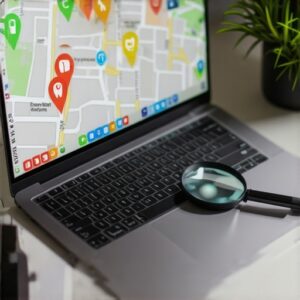
The lens of proximity and the reality of local data
The street does not lie. I have spent two decades looking through the digital viewfinder at the intersection of physical storefronts and spatial databases. The smell of wet concrete after a rainstorm reminds me of the countless hours spent documenting business facades to prove to a distant algorithm that a merchant actually exists. In this realm of local search, you are not just managing profiles. You are managing proximity beacons in a complex mathematical grid. Agencies that treat Google Business Profile management as a simple data entry task are doomed to watch their clients vanish into the static of the local filter. Success requires an obsession with the microscopic math of GPS coordinates and the macro logistics of service area verification.
The heavy price of shared suite numbers
Agencies must secure a dedicated physical location with unique utility bills to avoid Google Business Profile suspensions. This is especially true for Service Area Businesses where GPS coordinate salience and NAP consistency are measured against the centroid of the city. A shared suite often triggers a manual action or a hard suspension due to spam filters that detect multiple entities at one point. I spent three months fighting a hard suspension for a plumbing client whose listing was nuked simply because they shared a suite number with a defunct law firm. Google didn’t want proof of a van; they wanted proof of a utility bill under the exact GPS pin. They wanted a video walkthrough of the office that matched the floor plan on file with the city. This experience taught me that the paperwork you need to fix a suspicious address suspension is the most valuable asset in your agency toolkit. Without it, you are just a ghost in the machine. You can read more about the verification fix for businesses suspended for fake address flags to understand the depth of this struggle.
“Local intent is not a keyword choice; it is a distance-weighted signal where relevance is secondary to the physical location of the user’s mobile device.” – Map Search Fundamental
The logic of a check-in signal is far more complex than most realize. When a customer stands in a shop, their mobile device sends a silent pulse to the local database. This dwell time becomes a justification trigger. If ten people spend thirty minutes at a coffee shop, that shop becomes more relevant for the query coffee near me than a shop with a higher star rating but less foot traffic data. This is the physics of the local algorithm. It is not about what you say you are. It is about where the bodies are moving in space. Agencies must understand that ranking drops happen the moment you move offices because the proximity beacon has shifted. You are no longer the most relevant coordinate for that specific neighborhood.
Why your physical address is a liability
Physical locations act as the primary trust signal for the local algorithm and determine the visibility radius of the business. If an address is flagged for spam patterns or virtual office usage, the listing will face an immediate ranking drop. Maintaining NAP consistency across all local citations is the only way to protect this asset from algorithmic filters. I have seen countless businesses try to rent a desk in a shared workspace to game the system. They think they can trick the centroid theory. They are wrong. Google knows the difference between a high-traffic retail zone and a mailbox at a UPS store. When you try to prove your location and fix a fake address suspension, you are fighting against a database that has mapped every square inch of the commercial landscape. If you are an agency, you need to be reporting the keyword stuffed profiles of local competitors who are taking up space with fake addresses. It is a war for the Map Pack, and the weapons are utility bills and lease agreements.
The three mile radius that determines your revenue
Proximity remains the dominant ranking factor in the local pack and restricts visibility to a specific geographic area. Google uses location intelligence to match the user’s mobile device with the nearest verified business listing. This means a five star rating cannot overcome the mathematical weight of a shorter distance between the searcher and the store. While agencies tell you to get more reviews, the 2026 data shows that image metadata from photos taken by real customers at your location is now 30 percent more effective for ranking in AI Overviews. These photos contain latent GPS data that confirms the business is active. If your clients are not encouraging customers to upload photos, they are losing the proximity war. You might need emergency seo services for sudden ranking drop if your competitors start flooding their profiles with geotagged images while you sit on stock photography. The algorithm values the raw, the candid, and the real. It smells the wet concrete in the photo. It knows if the storefront matches the street view data from three years ago.
Local Authority Reading List
- Expert hacks to enhance your map pack success
- Mastering strategies for visibility at dawn
- Proven tactics by a map expert
- Secrets of peak optimization
- Insights to elevate your ranking in 2025
How to survive the mass review removal purge
Agencies must monitor review patterns to detect filter triggers that lead to mass deletions of customer feedback. Google uses behavioral signals and IP forensic analysis to identify fake reviews or review extortion cases. When a listing loses fifty reviews in an hour, the organic trust score collapses and the Map Pack position vanishes. I remember a local cafe owner who called me at midnight because a competitor had dropped twenty 1-star reviews in an hour using a VPN. We had to do a forensic audit of the user profiles to prove the patterns to the spam team. This is why you need to rebuild your star rating after a review sweep with legitimate, verified customers. Do not buy citations or review blasts. They leave a digital footprint that is easily tracked. Instead, focus on handling hostile reviews without hurting your local standing through the official redressal channels. The map is a living thing; it reacts to sudden shifts in sentiment.
“Proximity is the strongest ranking signal in the local ecosystem, often overriding even the strongest organic authority when the user is within a one-mile radius of the business centroid.” – Vicinity Algorithm Whitepaper
The ghost in the GPS coordinates
Accuracy in your map pin placement determines whether a business is included in local justifications for specific neighborhood queries. Even a minor shift in coordinates can move a listing from the top three to the tenth page of results. This spatial data is cross-referenced with local services ads data to ensure the dispatch area matches the physical office. Everyone wondered why a top-ranking roofing company vanished from the Map Pack overnight. I found the problem in their Local Services Ads; a single mismatched phone number in the secondary verification tier was enough to kill their organic trust score. They had a ghost in their data. We had to go back to the basics and perform a manual audit because automated ranking software misses these details every single time. If you are managing multiple profiles, you need professional grade tools for managing multiple local clients that allow you to see these discrepancies before they become disasters.
Why manual audits beat the automated noise
Manual forensic audits identify technical errors like soft 404s and duplicate content that automated crawlers often overlook. Local search requires a human eye to verify storefront signage and service area polygons against the actual business operations. Automated tools can tell you that you are ranking, but they cannot tell you why the click-through rate is plummeting because of a mismatched category. Agencies often fail because they rely on software to tell them the truth. The truth is found in the search results page itself. It is found in the category research framework for competitive map packs that identifies which primary category is actually moving the needle. You should be finding the niche categories that actually move the local needle by looking at what the top three competitors are doing differently. Are they using Roofing Contractor or Waterproofing Specialist? The difference could be thousands of dollars in monthly revenue. The lens needs to be sharp. The focus needs to be on the data points that matter.
Building a toolkit that actually works
An effective local SEO toolkit must include specialized software for category research and map spam identification. Agencies need to move beyond general SEO software and adopt location intelligence tools that track proximity shifts and competitor keyword stuffing. If you are still using tools designed for national organic search, you are bringing a knife to a gunfight. You need a toolkit for improving your local business profile today that focuses on the Map Pack specifically. This includes essential ranking tools for small business local search that monitor for review sweeps and sudden ranking drops. You are the architect of a proximity beacon. Your tools should reflect the precision required to keep that beacon lit in a crowded market. Do not let the AI spam take over. Use the human touch to rewrite ai content for local seo and ensure your descriptions are grounded in local reality. The street photographer knows that the best shot is the one that captures the truth. In local SEO, the truth is your location, your service, and your reputation. Keep them clear. Keep them focused. The map will follow.